Warning signs of a Heart Attack
- Posted on
- Comment
 Who Is At Risk
Many people think that heart attacks are a “man’s problem,” yet heart disease is actually the number one killer of both men and women in the United States. In men, the risk for heart attack increases significantly after the age of 45. In women, heart attacks are more likely to occur in the years after menopause (usually, after the age of 50). However, younger men and women can also have heart attacks.
Besides age, factors that increase the risk for heart attack are:
-
A previous heart attack or procedure to open up the coronary arteries
-
Family history of early heart disease:
–Father or brother diagnosed before age 55
–Mother or sister diagnosed before age 65
-
Diabetes mellitus
-
High blood cholesterol
-
High blood pressure
-
Cigarette smoking
-
Overweight
-
Physical inactivity
If you have one or more of these factors, see your health care provider to find out how to reduce your risk of having a heart attack.
During a heart attack, a clot in the heart’s artery blocks the flow of blood to the heart. Heart muscle begins to die. This is technically called a “myocardial infarction,” meaning “death of heart muscle.” The more time that passes without treatment, the greater the damage. The part of the heart that dies during a heart attack cannot grow back or be repaired.
Fortunately, clot-busting drugs and other artery-opening treatments, such as angioplasty, can stop a heart attack in its tracks. Given soon after symptoms begin, these treatments can prevent or limit damage to the heart. The quicker they are started, the more good they will do and the greater the chances are of a full recovery. To be most effective, these treatments should be given within 1 hour of the start of heart attack symptoms. The benefit of opening the blocked artery decreases with each passing hour from symptom onset until treatment.
Learn the Signs
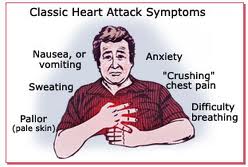
Many people think that a heart attack is sudden and intense, like the “Hollywood” heart attack depicted in the movies, where a person clutches his or her chest and falls over. The truth is that many heart attacks start as a mild discomfort in the center of the chest. Someone who feels such a warning may not be sure what is wrong. The discomfort (and other symptoms) may even come and go. Even people who have had a heart attack may not recognize the signs, because the next one can have entirely different symptoms. The warning signs of a heart attack are shown in the box below. Learn them, but also remember: Even if you’re not sure it’s a heart attack, you should still check it out promptly.
Heart Attack Warning Signs
-
Chest discomfort. Most heart attacks involve discomfort in the center of the chest that lasts for more than a few minutes or that goes away and comes back. The discomfort can feel like uncomfortable pressure, squeezing, or fullness.
-
Discomfort in other areas of the upper body. Symptoms can include discomfort in one or both arms or in the back, neck, jaw, or stomach.
-
Shortness of breath. This symptom often accompanies chest discomfort. However, it can also occur before the chest discomfort.
-
Other signs. These may include breaking out in a cold sweat, nausea, or light-headedness. Some patients report a sense of impending doom.
-ahajournals
ABOUT: Nana Kwesi Coomson
 [email protected]
 An Entrepreneur, Corporate Social Responsibility, Corporate Communications Executive and Philanthropist. Editor-in-Chief of www.233times.com. A Senior Journalist with Ghanaian Chronicle Newspaper. An alumnus of Adisadel College where he read General Arts. His first degree is in Bachelor of Arts - Political Science (major) and History (minor) from the University of Ghana. He holds MSc in Corporate Social Responsibility (CSR) and Energy with Public Relations (PR) from the Robert Gordon University in the United Kingdom. He is a 2018 Mandela Washington Fellow who studied at Clark Atlanta University in USA on the Business and Entrepreneurship track.
View all posts by: Nana Kwesi Coomson


 (Selorm) |
  (Nana Kwesi)