Ghana’s Initial Assessment Report On Mercury Launched
- Posted on
- Comment
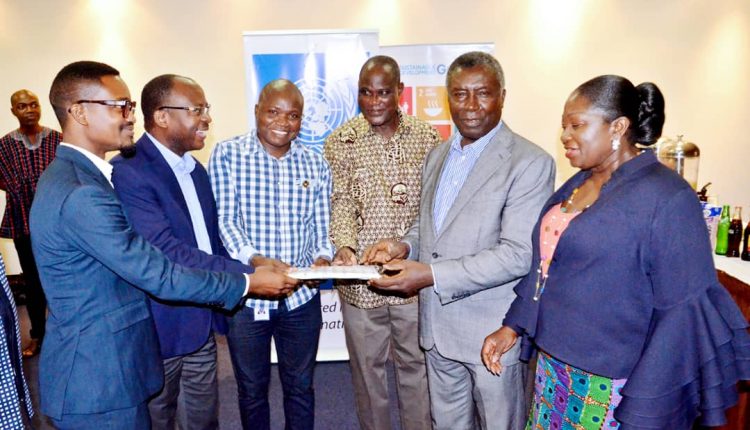
The United Nations Development Programme (UNDP) in partnership with the Ministry of Environment, Science, Technology and Innovation (MESTI), the Environmental Protection Agency (EPA) and the United Nations Institute for Training and Research (UNITAR) launched Ghana’s Minamata Initial Assessment Report, setting the tone for national discussions on mercury management in Ghana.
Ghana, being a party to the Minamata Convention which aims to phase-out / minimize mercury usage, undertook the assessment to understand the existing institutional and legal frameworks on mercury management, sources of mercury releases, the gaps that need to be filled, and actions required to ensure an effective implementation of the Convention.
Findings from the assessment identified the major mercury release sources in Ghana and these include gold extraction with mercury, mostly by artisanal small-scale gold miners; use and disposal of mercury-added products; waste incineration and open waste burning. The mercury releases, according to the report, are mostly emitted into the air, followed by water and land.
Speaking at the launch of the report, Prof. Kwabena Frimpong Boateng, Minister of Environment, Science, Technology and Innovation, expressed the Government’s satisfaction on the great efforts put in by key stakeholders to ensure that the assessment was carried out successfully and in good time. He stressed on the Ministry’s commitment to provide adequate support for the implementation of the recommended actions identified. He said, “Government will not relent in its effort to deal with illegalities in artisanal & small-scale gold mining, especially the use of mercury as this affects the environment”.
The report also noted that, though Ghana does not mine mercury, it imports mercury and mercury-containing products, and these are mostly used by artisanal small-scale gold miners; educational and research institutions; health care facilities; meteorological services and other allied institutions. The devices being used by these institutions are mainly thermometers, manometers, barometers, sphygmomanometers, and analytical equipment.
In terms of the risk of mercury exposure, the report indicated that the most vulnerable groups are: communities close to water bodies and mining sites; patients, health personnel and people living close to health facilities that use mercury-added products; and those living near open dumps and waste incineration sites.
Priority actions recommended by the report towards the effective implementation of the Minamata Convention in Ghana include:
- developing a legal framework that incorporates the obligations under the Minamata Convention as well as an administrative structure;
- phasing-out the use of mercury-added products in the health sector and reducing the use of dental amalgam;
- reducing and where feasible, eliminating the use of mercury and mercury compounds in artisanal small-scale gold mining;
- reducing emissions and releases of mercury from the identified mercury releases sources; and
- managing mercury waste in an environmentally-sound manner.
In his remark at the launch of the report, Mr Louis Kuukpen, Assistant Country Director of UNDP, called on leading national institutions to prioritize the implementation of these recommended actions to protect Ghanaians and the environment from the adverse effects of mercury exposure.
“The Sustainable Development Goals (SDGs) and the Paris Agreement on Climate Change call for the commitment of all stakeholders to ensure environmental sustainability. We at UNDP stand ready to continue to partner our government and other development partners to work towards the realization of these global goals”, noted Mr Kuukpen.
The Minamata Convention on Mercury is a global treaty to protect human health and the environment from the adverse effects of mercury. The Convention focuses on ultimately phasing-out mercury and mercury-related or containing products from all sectors. Ghana ratified the Minamata Convention in August 2017.
ABOUT: Ellsamwise King
 [email protected]
 A Civil/Structural Engineer & Freelance Blogger, Journalist, Social Media Mogul, Digital Marketer, Entrepreneur, and Philanthropist. CEO of Skyline Consortium & 9189 Media Consult and Co-Founder of Team Sarkodie. An alumnus of Prempeh College where he read General Science. He holds a first degree in Bachelor of Science from the Kwame Nkrumah University of Science and Technology. His mentors are Alvar Alto, Rupert Murdoch, Piers Mogan, Mensa Otabil, Bernard ElBernard Nelson-Eshun. Blogs for; http://www.233times.com | www.paemuka.com | http://www.playmusicgh.com | http://www.muzikiq.com | http://www.brandsaid.biz . Social Media Manager for Eon3 Group | BrandsAid | Kings Crown Media | Carabao Africa Ghana & Africa | Calvary Temple - ICGC | Team Sarkodie | Muzik IQ | Kwaw Kese Please inquire more via Email: [email protected] | [email protected] Instagram & Twitter: @wise_tskd Facebook: Ell Samwise LinkedIn: EllSamwise King Dogbe
View all posts by: Ellsamwise King



 (Selorm) |
  (Nana Kwesi)