Does this look like a real woman? AI Vogue model raises concerns about beauty standards
- Posted on
- Comment
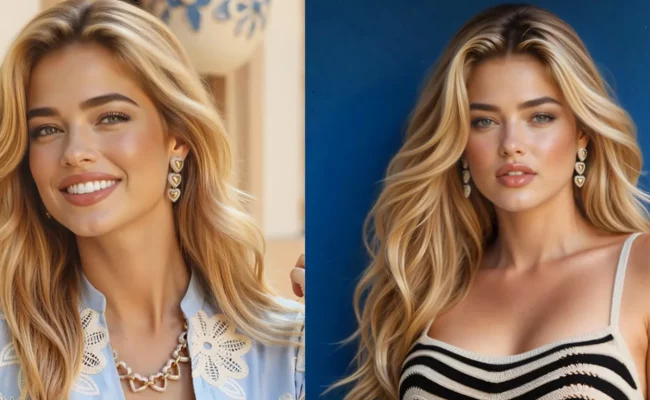
There’s a new supermodel in town. She’s striking, stylish… and not real.
In August’s print edition of Vogue, a Guess advert features a flawless blonde model showing off a striped maxi dress and a floral playsuit from the brand’s summer collection.
In small print in one corner, the ad reveals that she was created using AI.
While Vogue says the AI model was not an editorial decision, it is the first time an AI-generated person has featured in the magazine.
The advert has been met with controversy and raises questions about what this means for real models who have fought for greater diversity, and for consumers – particularly young people – already struggling with unrealistic beauty standards.
Seraphinne Vallora is the company behind Guess’s controversial advert.
Its founders, Valentina Gonzalez and Andreea Petrescu, tell the BBC they were approached by Guess’s co-founder, Paul Marciano, on Instagram and were asked to create an AI model as part of the brand’s summer campaign.
“We created 10 draft models for him and he selected one brunette woman and one blonde that we went ahead and developed further,” Gonzalez says
She explains there’s often a misconception that AI image generation is simple, saying it is actually a complex process.
The company has five employees who create AI models, and it can take up to a month from idea inception to the completed product. The pair say they charge anywhere up to low six figures for a client like Guess.
‘Disheartening’
But Felicity Hayward, a plus-size model who has been in the industry for more than a decade, says using AI models in fashion campaigns “feels lazy and cheap”.
“Either Guess is doing this to create a talking point and get free publicity or they want to cut costs and don’t think about the implications of that.”
She describes Vogue’s decision to include the advert as “very disheartening and quite scary”, and worries it could undermine years of work towards more diversity in the industry.
The fashion world was making real progress to be more inclusive in the 2010s – the decade saw Valentina Sampaio become the first openly trans model to walk for Victoria’s Secret, Halima Aden was the first hijab-wearing model in global campaigns, and brands like Savage x Fenty featured plus-size models on the runway.
But in recent years, Hayward believes, the industry has slipped backwards because “these people are just not getting booked any more”.
And the use of AI models is “another kick in the teeth, and one that will disproportionately affect plus-size models”, she warns.
-BBC
ABOUT: Nana Kwesi Coomson
 [email protected]
 An Entrepreneur, Corporate Social Responsibility, Corporate Communications Executive and Philanthropist. Editor-in-Chief of www.233times.com. A Senior Journalist with Ghanaian Chronicle Newspaper. An alumnus of Adisadel College where he read General Arts. His first degree is in Bachelor of Arts - Political Science (major) and History (minor) from the University of Ghana. He holds MSc in Corporate Social Responsibility (CSR) and Energy with Public Relations (PR) from the Robert Gordon University in the United Kingdom. He is a 2018 Mandela Washington Fellow who studied at Clark Atlanta University in USA on the Business and Entrepreneurship track.
View all posts by: Nana Kwesi Coomson





 (Selorm) |
  (Nana Kwesi)