Effia Constituency: Rare collaboration between NPP MP and NDC MCE
- Posted on
- Comment
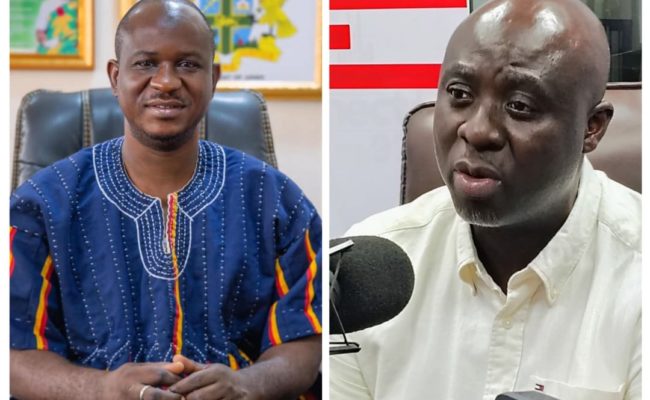
An infectious yet exemplary spirit of collaboration is beginning to spring in Effia, in the Western Region, between an unlikely duo, the Member of Parliament, Isaac Boamah Nyarko, and Municipal Chief Executive Abdul Majeed Iddrisu Nassam, one that could redefine the constituency’s development story.
The newfound recognition between the two, that Effia’s development should supersede any differences, is remarkable considering their turbulent past. They were fierce rivals in the 2024 parliamentary elections — a contest so heated it descended into vandalism and the burning of properties.
Lawyer Boamah Nyarko, then the New Patriotic Party (NPP) candidate, narrowly clinched victory. His opponent, the National Democratic Congress (NDC)’s Abdul Nassam, challenged the results in court. It was the kind of bitter fallout that often leaves deep scars in the country’s local politics, scars that can paralyse development long after the ballots are counted.
Across the country, tensions between Members of Parliament and Metropolitan, Municipal, and District Chief Executives (MMDCEs) are a recurring story, especially when they come from different political parties. Too often, projects are delayed, halted, or duplicated as both sides compete for political visibility. Road rehabilitations are paused, schools are abandoned, and community projects are rebranded to deny an opponent credit, an instance where the ordinary citizen pays the price for partisan paralysis.
Effia could easily have fallen into the same trap. But recent months suggest a conscious effort by both the MP and the MCE to chart a different path, one that prizes shared purpose over political pride.
Speaking on ConnectFM’s political talk show Asem Yi Dzi Ka, the MP Isaac Boamah Nyarko used a tone rarely heard in the country’s hyper-partisan climate. He openly praised his one-time rival, now MCE, for his role in a successful National Sanitation Day exercise.
“We need to give commendation when a good deed is done. I am also doing my best with all the resources I have. I will never shy away from supporting my constituents… his efforts and mine, together, will help propel Effia to greater heights.”
His words of sincerity were a symbolic moment where an elected NPP MP publicly crediting an NDC-appointed MCE for effective work. For observers used to political trench warfare, it hinted at something more than courtesy, one that signaled a pragmatic shift.
For the MCE Abdul Majeed Iddrisu Nassam, the feeling seems mutual. Speaking in a separate interview, he recognised that the elections were over and, equally, the time for score-settling had passed.
“Effia’s development is paramount. Any differences should not stand in the way. I cannot shoulder the challenges of Effia alone. Therefore, other efforts from wherever, including that of the MP, should get all the necessary support.”
He recalls being urged by close associates to “match” the MP’s gestures of philanthropy, of donations of mattresses, equipment, and support to households. But his response is telling: “I am not in competition with him. We are both serving different offices… If he gives to one side of Effia, I can give to the other. What matters is that the people of Effia benefit.”
Such statements might sound routine, but given the politically charged landscape, they are groundbreaking. The “winner-takes-all” mentality, where election victories translate into exclusive control of state power, undermines local development. In many districts, MPs and MMDCEs refuse to share credit, fearing it could boost a rival’s popularity. That rivalry has cost communities dearly, delaying infrastructure and fragmenting public trust in governance.
Isaac Boamah Nyarko and Abdul Majeed Iddrisu Nassam’s new spirit of cooperation, therefore, needs applause. A partnership rooted not in political convenience, but in a mutual recognition that neither the MP nor the MCE can single-handedly transform the constituency.
However, sceptics wonder how long this truce will last as political seasons are short, and alliances often give way to ambition. If the duo succeeds, Effia might just offer a blueprint for how local politics can evolve from adversarial competition to shared responsibility. And if they fail, it will be yet another reminder of how easily personal rivalry can stall the progress of an entire constituency.
Until then, residents of Effia dare to hope.
By Eric Yaw Adjei
ABOUT: Nana Kwesi Coomson
 [email protected]
 An Entrepreneur, Corporate Social Responsibility, Corporate Communications Executive and Philanthropist. Editor-in-Chief of www.233times.com. A Senior Journalist with Ghanaian Chronicle Newspaper. An alumnus of Adisadel College where he read General Arts. His first degree is in Bachelor of Arts - Political Science (major) and History (minor) from the University of Ghana. He holds MSc in Corporate Social Responsibility (CSR) and Energy with Public Relations (PR) from the Robert Gordon University in the United Kingdom. He is a 2018 Mandela Washington Fellow who studied at Clark Atlanta University in USA on the Business and Entrepreneurship track.
View all posts by: Nana Kwesi Coomson



 (Selorm) |
  (Nana Kwesi)