Middle East tensions: Ghana has over 5 weeks of fuel in stock – NPA assures
- Posted on
- Comment
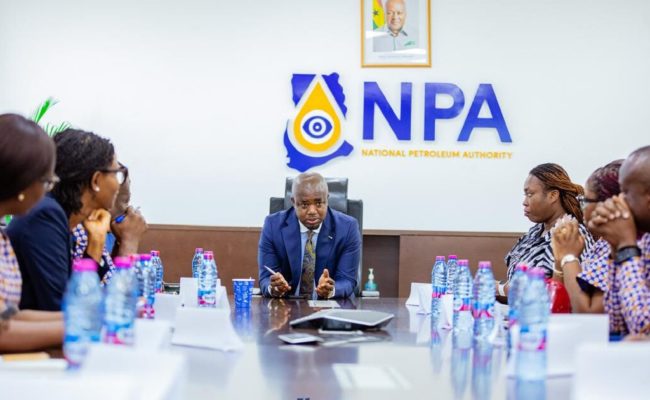
The National Petroleum Authority (NPA) has moved to calm public anxiety over potential fuel shortages, assuring Ghanaians that the country has adequate petroleum stocks despite escalating tensions in the Middle East.
Speaking on JoyNews on Sunday, March 1, the Director of Economic Regulation and Planning at the NPA, Abass Ibrahim Tasunti, disclosed that current fuel reserves remain strong.
“As of last Friday, we have diesel stocks to last us over five weeks. Roughly, it will last us up to 5.3 weeks. And then for petrol, we have almost 6.8 weeks to last,” Mr Tasunti said.
He clarified that these stock levels are not a reaction to the ongoing crisis but form part of the Authority’s routine mandate to guarantee uninterrupted fuel supply.
“Even without this war, we always ensure that we have a plan to make petroleum products available for consumers in the country. So this is not something that is being done because of the war, but it is something we do regularly. It is one of NPA’s major mandates,” he explained.
According to him, the Authority oversees daily discharge of imported petroleum products while domestic production also supplements supply.
He noted that the Sentuo oil refinery has been consistently producing since June 2025, supplying petroleum products to the market. Additionally, the Atuabo Gas Processing Plant continues to produce and distribute liquefied petroleum gas (LPG).
Mr Tasunti further revealed that several vessels are currently waiting to discharge at the Tema anchorage, including two cargoes of diesel and two cargoes of petrol, with additional imports already scheduled.
While assuring the public of supply stability, the NPA acknowledged that Ghana, as a net importer of petroleum products, will inevitably feel the impact of global oil market disruptions.
In a related development, the Chamber of Petroleum Consumers (COPEC) has also warned that ongoing hostilities in the Middle East could affect pricing in the coming weeks.
Executive Secretary Duncan Amoah cautioned that traders are already factoring geopolitical risks into future cargo pricing decisions.
“If I was a trader and I woke up tomorrow to have to put stock on the market, I would definitely bear in mind the fact that these hostilities or tensions prevailing within the Middle East could affect the next cargo consignment that I get down here,” he stated.
His comments follow a surge in global crude prices to above $91 per barrel after disruptions linked to tensions around the Strait of Hormuz, a key global oil transit route.
ABOUT: Nana Kwesi Coomson
 [email protected]
 An Entrepreneur, Corporate Social Responsibility, Corporate Communications Executive and Philanthropist. Editor-in-Chief of www.233times.com. A Senior Journalist with Ghanaian Chronicle Newspaper. An alumnus of Adisadel College where he read General Arts. His first degree is in Bachelor of Arts - Political Science (major) and History (minor) from the University of Ghana. He holds MSc in Corporate Social Responsibility (CSR) and Energy with Public Relations (PR) from the Robert Gordon University in the United Kingdom. He is a 2018 Mandela Washington Fellow who studied at Clark Atlanta University in USA on the Business and Entrepreneurship track.
View all posts by: Nana Kwesi Coomson




 (Selorm) |
  (Nana Kwesi)