It further said that girls perform better than boys in reading for most age group.
However, it pointed out that girls underachieve in numeracy tests as compared to boys.
According to the study, 7.2 percent of girls under age five perform better in reading whereas compared to 1.9 percent boys.
Additionally, it noted that there are substantial gender differences in Information and Communication Technology (ICT) skills.
Touching on enrollment, the study stated that with the exception of Western, Volta, Upper East and Northern regions, boys enrollment in Senior High Schools (SHS) is higher than girls.
“Among girls age fifteen to nineteen, poverty and teenage pregnancy are the major factors affecting school enrollment,” it mentioned
Speaking at a workshop on Human Capital Development in Accra, World Bank Country Director , Henry Kerali bemoaned that governments in Africa are overly concentrated on investing in physical capital such as roads, bridges etc but are less interested in the investment of human capital.
He said apart from cognitive abilities, health also matters in human capital development, stressing that “the different dimensions of human capital complement one another starting at an early age”.
According to Kerali, the World Bank analysis suggests that a child born in Ghana today would be 44 percent as productive when that child grows up if that child enjoyed complete education and full health.
Mr Kerali said that the purpose of the workshop was to identify key challenges Ghana faces in enhancing human capital development and generate policy recommendations.
Boys enrollment in SHS higher than girls – Report
- Posted on
- Comment
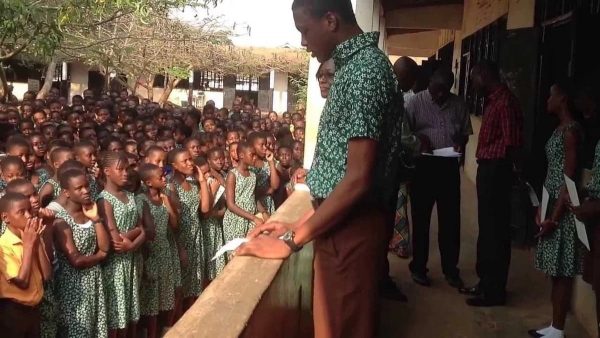
A research by the World Bank shows that girls under age five do better in cognitive development than boys.
By John APPIAH, Accra
ABOUT: Nana Kwesi Coomson
 [email protected]
 An Entrepreneur, Corporate Social Responsibility, Corporate Communications Executive and Philanthropist. Editor-in-Chief of www.233times.com. A Senior Journalist with Ghanaian Chronicle Newspaper. An alumnus of Adisadel College where he read General Arts. His first degree is in Bachelor of Arts - Political Science (major) and History (minor) from the University of Ghana. He holds MSc in Corporate Social Responsibility (CSR) and Energy with Public Relations (PR) from the Robert Gordon University in the United Kingdom. He is a 2018 Mandela Washington Fellow who studied at Clark Atlanta University in USA on the Business and Entrepreneurship track.
View all posts by: Nana Kwesi Coomson


 (Selorm) |
  (Nana Kwesi)