Trump accused of directing hush money
- Posted on
- Comment
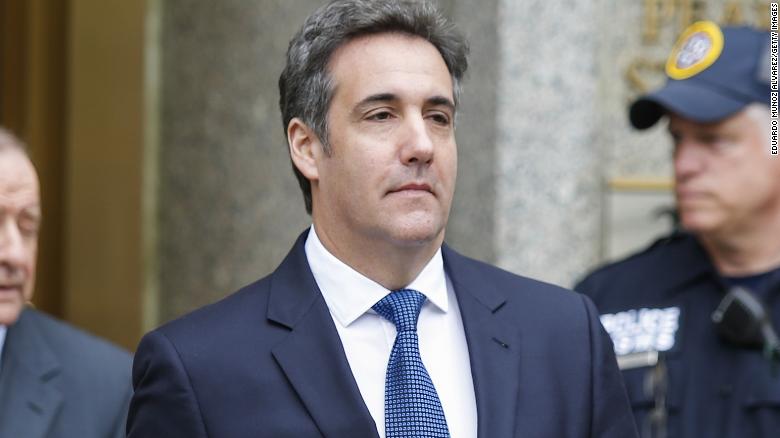
US President Donald Trump’s former lawyer, Michael Cohen, has pleaded guilty in a New York court to violating campaign finance laws.
He said he had done so at the direction of “the candidate”, for the “principal purpose of influencing [the] election”.
The admission was related to hush money paid to Mr Trump’s alleged lovers.
Mr Trump has not commented. In May, he admitted reimbursing Cohen for paying one of the women, having earlier denied any knowledge of it.
Cohen, 51, admitted eight counts on Tuesday, including tax and bank fraud, in a plea deal with prosecutors which may see his prison sentence reduced from 65 years to five years and three months.
On the same day, a jury in Alexandria, Virginia, convicted former Trump campaign chairman Paul Manafort of bank and tax fraud charges.
The developments in the Cohen and Manafort cases have revived speculation that the president himself may face legal proceedings.
What happened in court?
Clearly referring to Mr Trump, Cohen said he had been directed by “a candidate for federal office” to break federal election laws.
Cohen pleaded guilty to counts of tax evasion, making false statements to a financial institution, wilfully causing an unlawful corporate contribution and making a campaign contribution at the request of a candidate or campaign.
Sentencing was set for 12 December and he was released on bail of $500,000 (£390,000).
Cohen’s voice quavered as he answered routine questions from the judge. Asked whether he had consumed any alcohol or drugs before making his guilty plea, he told Judge William Pauley he had only had a glass of 12-year-old Glenlivet, a single-malt scotch, with dinner the night before.
‘Lock him up!’
Nick Bryant, BBC News, in court
This was the legal summer blockbuster that journalists had been waiting months for and, in terms of courtroom drama and potential political impact, the appearance of Michael Cohen, Donald Trump’s one-time Mr Fix-it, didn’t disappoint.
It was his admission that he had knowingly broken campaign finance laws that was by far the most politically explosive.
It was extraordinary to hear him tell the court that he had done so in co-ordination with, and at the direction of, the candidate.
Though he did not mention his name – or those of the women in question – the candidate is, of course, his former boss, Mr Trump.
Though Cohen has admitted guilt, he has not agreed as part of the plea agreement to co-operate with federal prosecutors, either in New York or those working on the investigation led by the special counsel Robert Mueller.
He left court to chants of “lock him up” from a few of his fellow New Yorkers.
What did prosecutors say?
Robert Khuzami, the deputy US attorney for the Southern District of New York, said Cohen’s crimes had been “particularly significant” because he was a trained lawyer.
Cohen, he said, had failed over the past five years to report income on $1.3m from a taxi business, $100,000 from brokerage commissions and $200,000 from consultancy fees.
He said Cohen had provided “sham” invoices to the campaign for legal fees that he allegedly provided last year.
The prosecutor also said Cohen had sought reimbursement for his “excessive campaign contribution” by submitting the bogus invoices to the campaign.
Why was hush money paid?
Porn star Stormy Daniels says she was paid $130,000 by Cohen just days before the 2016 election to keep quiet about an affair she says she had a decade earlier with Mr Trump.
Cohen also recorded a conversation with Mr Trump two months before the election in which they discussed buying the rights to a kiss-and-tell story by former Playboy model Karen McDougal who says she had an affair with Mr Trump.
McDougal apologises for ‘Trump affair’
Undisclosed payments to bury embarrassing stories about a political candidate can be treated as a violation of US campaign finance laws.
The lawyer for Ms Daniels – who is suing both Mr Trump and Cohen for defamation – tweeted that the court developments had boosted her case against the president.
How did Trump and Cohen’s lawyers react?
Cohen’s lawyer said his client was living up to his vow in an interview last month to put his loyalty to family and country above his old boss.
Mr Davis said: “Today he stood up and testified under oath that Donald Trump directed him to commit a crime by making payments to two women for the principal purpose of influencing an election.”
How did the case come about?
Cohen worked at the Trump Organization for more than a decade and continued to serve as Mr Trump’s personal lawyer and fixer after the election.
The FBI seized a number of files in April from Cohen’s office and a hotel room used by him in New York.
They had conducted the raid reportedly following a tip-off from Robert Mueller’s team.
Could Trump go on trial?
“If those payments were a crime for Michael Cohen, then why wouldn’t they be a crime for Donald Trump?” Cohen’s lawyer, Lanny Davis, asked after Tuesday’s proceedings.
Rudy Giuliani, a lawyer for Mr Trump, told reporters that there had been “no allegation of any wrongdoing against the president” in the charges against Cohen.
In any case, Mr Trump is unlikely to face criminal charges as long as he remains president, legal experts say.
What is conceivable is that he could be sacked by Congress under the US constitution’s provision for impeaching a president over “high crimes and misdemeanours”.
For that to happen, Mr Trump’s opponents in the Democratic Party would have to win control of both houses.
How easy is it to impeach a president?
Even if they did well in the mid-term elections in November, they would almost certainly need to persuade members of Mr Trump’s Republicans to change sides over the issue.
No US president has ever been removed from office on the basis of impeachment.
The chances of impeachment would increase dramatically were an ongoing investigation led by Robert Mueller to conclude that the Trump campaign had colluded with Russia to sway the 2016 election – a charge denied by Russia and described by Mr Trump as a “witch hunt”.
Cohen’s lawyer said his client was keen to “tell truth to power” and that what he had to say was going to be of great interest to Mr Mueller.
Speaking at a rally in West Virginia, Mr Trump said the Cohen and Manafort cases did not involve him and had “nothing to do with Russian collusion”.
Source: BBC
ABOUT: Ellsamwise King
 [email protected]
 A Civil/Structural Engineer & Freelance Blogger, Journalist, Social Media Mogul, Digital Marketer, Entrepreneur, and Philanthropist. CEO of Skyline Consortium & 9189 Media Consult and Co-Founder of Team Sarkodie. An alumnus of Prempeh College where he read General Science. He holds a first degree in Bachelor of Science from the Kwame Nkrumah University of Science and Technology. His mentors are Alvar Alto, Rupert Murdoch, Piers Mogan, Mensa Otabil, Bernard ElBernard Nelson-Eshun. Blogs for; http://www.233times.com | www.paemuka.com | http://www.playmusicgh.com | http://www.muzikiq.com | http://www.brandsaid.biz . Social Media Manager for Eon3 Group | BrandsAid | Kings Crown Media | Carabao Africa Ghana & Africa | Calvary Temple - ICGC | Team Sarkodie | Muzik IQ | Kwaw Kese Please inquire more via Email: [email protected] | [email protected] Instagram & Twitter: @wise_tskd Facebook: Ell Samwise LinkedIn: EllSamwise King Dogbe
View all posts by: Ellsamwise King



 (Selorm) |
  (Nana Kwesi)